
A clear solution backed by regional consensus
For the first time, Québec’s Ministry of Transport and Sustainable Mobility (MTMD) and the region have reached the same conclusion. The solution is known, has been studied, and can be implemented on land that is already publicly owned.
MTMD technical recommendation
An uninterrupted highway link is recommended, as it best meets the identified needs and the mobility vision originally defined.
Recommendation from the MRC de Vaudreuil-Soulanges’ brief
Fully remove the traffic lights along the entire studied stretch of Highway 20, on both the Vaudreuil-Dorion and Île Perrot sides.
The vision, end to end
From Route 342 to the Galipeault Bridge, uninterrupted traffic flow replaces the current nine traffic lights, soon to be ten. Here’s what changes over the 7-km stretch, on both the Vaudreuil-Dorion and Île Perrot sides.
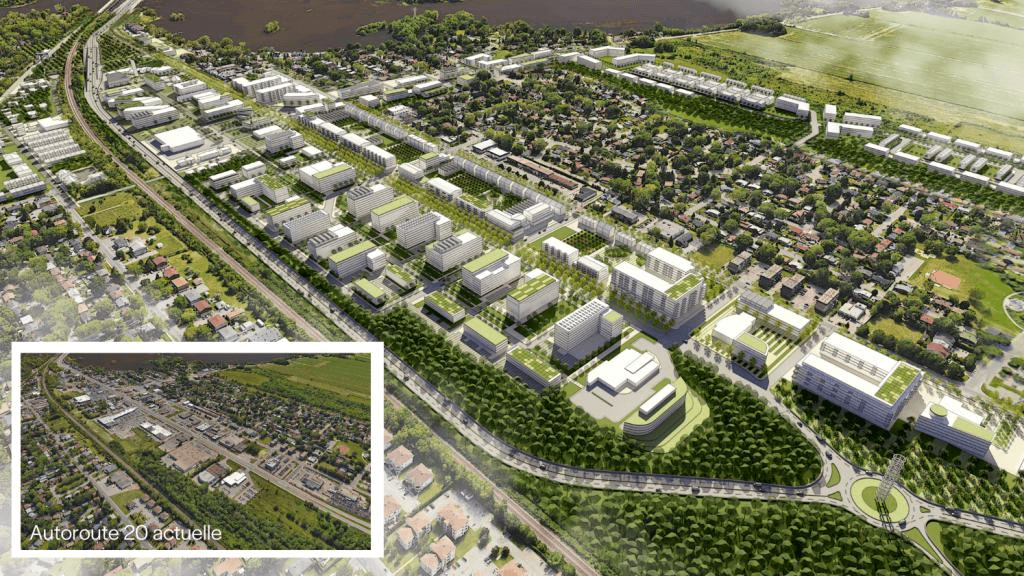
What an optimized Highway 20 would make possible
Projection of the Harwood sector once the project is completed; inset: Highway 20 as it stands today. Source: Harwood Sector PPU, De Lotbinière.
The solution, in plain terms
Uninterrupted traffic flow from Route 342 in Vaudreuil-Dorion to the Galipeault Bridge, with no traffic lights.
On Île Perrot: traffic lights replaced by proper highway access ramps.
Safer crossings for pedestrians and cyclists, and improved access to Exo train stations.
Connecting Terrasse-Vaudreuil to the rest of the region and reconnecting neighbourhoods that have been divided by Highway 20 for far too long.
On the Vaudreuil-Dorion side: a new alignment slightly north of Harwood Boulevard.
Infrastructure designed to support the development of public transit.
The decisive advantage:
The project would be built entirely on land already owned by the Government of Québec. No new expropriations would be required, significantly reducing timelines and costs.

$1.1B in avoidable losses
Over 20 years for Québec’s economy. Investing now means avoiding the cost of the status quo.

Greater safety
An end to dangerous points, easier emergency access and safe crossings for everyone.

Lower GHG emissions
Fewer stops and restarts mean fewer emissions and a better quality of life.

Better land-use planning
A direct response to the Government’s Land Use Planning Guidelines (OGAT) and the CMM’s Metropolitan Land Use and Development Plan (PMAD).